

Views: 0 Author: Site Editor Publish Time: 2026-09-16 Origin: Site


Frameless shower enclosure failures rarely stem from hardware malfunctions. Water leakage and hinge degradation usually happen because someone specified the incorrect seal geometry. Misaligned magnetic polarity compromises watertight integrity on the spot. Forcing an incompatible seal angle onto a glass-to-glass joint leads to rapid aesthetic deterioration and structural stress. This creates unnecessary maintenance costs for property managers and homeowners alike. You must match the seal profile strictly to the enclosure’s architectural geometry. Whether you need a 90°, 135°, or 180° configuration, precision matters. We will explore the exact evaluation criteria for selecting standard, dual-use, or custom profiles. You will learn how to secure reliable closures for both residential and commercial applications. Getting the geometry right stops leaks before they start and keeps the bathroom floor dry.
Geometry Dictates Function: The choice between a 90°, 135°, or 180° seal is non-negotiable and strictly determined by the intersection angle of the glass panels; incorrect application leads to immediate closure failure.
Matched Sets are Mandatory: Magnetic seals must be procured and installed as paired sets (Polarity A and Polarity B) to ensure a reliable, watertight snap-closure.
Dual-Use Innovations: Dual-use magnetic seals (capable of both 90° and 180° applications) offer inventory flexibility for contractors and bulk buyers, though specialized single-angle seals may provide tighter tolerances in custom builds.
Material Quality Matters: High-grade, co-extruded polycarbonate or PVC is required to maintain a clear appearance, resist UV yellowing, and ensure reliable magnetic closure over thousands of cycles.
Supplier Capabilities: For large-scale projects, partnering with a verified magnetic shower seal supplier capable of stable OEM production and custom specifications is critical for quality control and scalable deployment.
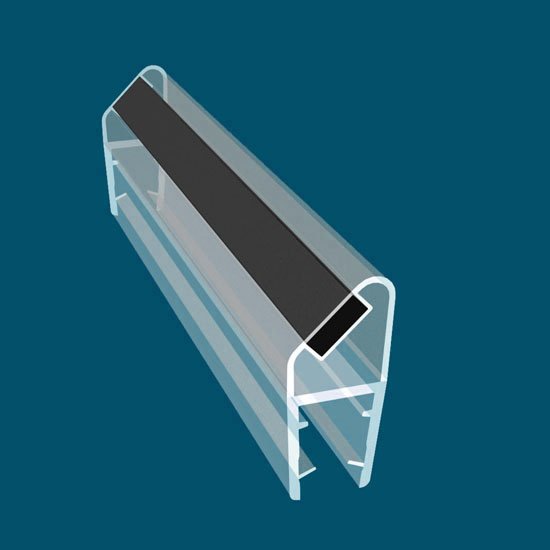
A reliable magnetic shower door seal relies on precise co-extrusion technology. Manufacturers embed flexible magnetic strips inside rigid plastic profiles. The rigid section grips the glass edge tightly. The flexible housing allows the magnets to meet and form a watertight barrier. This snap-closure mechanism prevents water from escaping the wet area. It also keeps the heavy glass door securely closed against water pressure from the showerhead.
You must always purchase and install these seals as matched sets. Magnetic strips feature specific polarity arrangements. One side acts as Polarity A, and the other acts as Polarity B. If you mix unmatched seals, the magnetic poles will repel each other. This creates a gap that allows water to flood the bathroom floor. A matched pair guarantees that the poles attract, ensuring a perfectly flush seal every time the door swings shut. Installers often waste hours trying to adjust hinges when the real issue is mismatched magnetic polarity.
Evaluating seal quality requires looking at specific performance metrics. First, check the gap accommodation. A standard high-quality seal bridges gaps between 8mm and 12mm effectively. Second, verify glass thickness compatibility. Profiles are rigidly extruded to fit 6mm, 8mm, 10mm, or 12mm glass. Forcing a 10mm seal onto 12mm glass will shatter the plastic housing. Finally, assess the material's resistance to hard water scaling. Smooth, non-porous PVC prevents mineral buildup, keeping the magnetic attraction strong over years of daily use.
Performance Metric | Standard Specification | Field Application Notes |
|---|---|---|
Gap Accommodation | 8mm to 12mm | Measure the gap at the top, middle, and bottom to account for out-of-plumb walls. |
Glass Thickness | 6mm, 8mm, 10mm, 12mm | Use digital calipers. Never guess the thickness based on visual inspection. |
Material Composition | Co-extruded PVC / Polycarbonate | Look for UV-resistant additives to prevent yellowing under bathroom lighting. |
Magnetic Pull Force | Matched Polarity (A+B) | Test the snap-closure before final installation to confirm poles attract. |
Diagnosing your enclosure geometry is the first step before ordering replacement parts. Many people guess their shower layout and order the wrong configuration. This results in wasted time and immediate installation failure. You can visually identify your shower layout by looking at where the moving door meets the stationary panel. The angle of this intersection dictates the exact seal profile you need.
Mapping the shape to the correct angle is straightforward. If your shower sits in a corner and the door meets the side panel at a sharp right angle, you need a 90° configuration. If you have a diamond-shaped or neo-angle enclosure, the door meets the side glass at a softer, obtuse angle. This requires a 135° profile. If your shower features a straight line of glass where the door aligns completely flat with the adjacent panel, you must use a 180° profile.
Using a simple square tool or a protractor can help verify the angle on site. Do not rely on visual estimates if the walls appear slightly out of plumb. Precise measurement prevents binding and ensures the magnets engage with maximum surface area. Contractors should carry an angle finder in their toolkits to confirm the geometry before cutting any extrusions.
Enclosure Type | Intersection Angle | Required Seal Geometry | Common Application |
|---|---|---|---|
Corner Unit | Right Angle (Perpendicular) | 90° Profile | Square or rectangular corner showers. |
Neo-Angle Unit | Obtuse Angle | 135° Profile | Diamond-shaped corner enclosures. |
Inline Unit | Straight Line (Flat) | 180° Profile | Alcove showers or straight glass walls. |
The primary structural application for a 90 degree magnetic shower seal is the standard corner enclosure. In this layout, the swinging glass door meets a fixed glass panel or a tiled wall at a strict right angle. This perpendicular design is highly common in residential bathrooms where space optimization matters. The seal must bridge the 90-degree corner seamlessly to prevent high-pressure shower spray from leaking out onto the bathroom floor.
The closure dynamics of a 90-degree setup rely on internal geometry. The magnetic strips sit at exact 45-degree angles within the plastic extrusion. When the door swings shut, the two 45-degree faces meet to form a perfect 90-degree corner. This design ensures the magnetic faces sit perfectly flat against each other. Maximum surface contact translates directly to maximum holding power and watertight integrity. If the angle is off even slightly, the magnets will only touch at the edge, drastically reducing the pull force.
Implementation realities often involve managing hinge stress. If the chosen 90-degree seal is too thick for the existing glass gap, closing the door will force the hinges outward. This constant pressure can loosen wall anchors or damage the hinge mechanisms over time. You must measure the strike edge accurately. Ensure the gap between the glass panels accommodates the combined thickness of both seal profiles without causing the door to bind. Installers should check the gap with the door fully closed and fully open to ensure consistent clearance.
Neo-angle and diamond-shaped enclosures absolutely require a 135 degree magnetic shower seal. These architectural designs feature a center door flanked by two angled stationary panels. The door does not meet the fixed glass straight on, nor does it meet at a sharp right angle. Instead, it approaches at an obtuse 135-degree angle. Standard seals cannot bridge this specific geometric gap. Attempting to modify a standard seal for this application will result in immediate failure.
Managing shear force is the biggest challenge in 135-degree closures. Because the door approaches the fixed panel at an angle, the magnetic pull engages differently than in flat closures. The magnets must catch smoothly without causing the door to over-travel or bounce back. If the magnetic attraction is too weak, the door will swing past the center point. If it is too aggressive, the sudden stop will send vibrations through the glass. This vibration can loosen mounting hardware over months of daily use.
These enclosures suffer from high tolerance sensitivities. 135-degree layouts leave the lowest margin for error during glass cutting and installation. Even a slight wall bowing can throw the angle off by a few degrees. The seal must remain flexible enough to accommodate these slight dimensional variations. It has to maintain a continuous watertight barrier even if the glass panels are slightly out of perfect alignment. Installers often use shims during the initial setup to ensure the glass panels align perfectly before applying the final silicone sealant.
Straight glass-to-glass enclosures rely on the 180 degree magnetic shower seal. You will find this setup in alcove showers or large walk-in enclosures. The sliding or pivot door aligns completely flat with the adjacent stationary panel. The two edges face each other directly in a straight line. This inline configuration requires a seal that pulls straight across the gap without any angled deflection.
Thermal expansion and gap management are major factors here. Inline configurations are highly susceptible to building settling. As a house shifts, the distance between the two glass panels can widen or narrow. The 180-degree seal must maintain solid magnetic contact even if the gap fluctuates by 1-2mm over the seasons. High-quality profiles feature slightly extended magnetic housings that reach across fluctuating gaps to ensure consistent closure. If the gap becomes too wide, the magnets will lose their grip, and the door will drift open during a shower.
Aesthetic considerations play a massive role in 180-degree applications. The seal sits directly in the center of a flat, transparent glass expanse. It is highly visible from both inside and outside the shower. Therefore, a clear, unobtrusive appearance is heavily scrutinized. UV resistance becomes a primary evaluation dimension. Low-grade plastics will yellow quickly under bathroom lighting and natural sunlight, ruining the clean look of a frameless enclosure. Property managers should specify UV-treated polycarbonate to extend the visual lifespan of the installation.
Dual-use technology engineers a single magnetic shower seal to function in both 90° and 180° configurations. Manufacturers achieve this by utilizing a specialized magnetic pole arrangement and a highly flexible housing. The profile features a rounded or multi-faceted strike face. This geometry allows the opposing magnets to lock together securely whether they approach head-on (180°) or from the side (90°).
The advantages of dual-use seals are significant for industry professionals. They streamline inventory for installers and reduce SKU management for distributors. Contractors can carry one type of seal in their trucks and handle multiple job site layouts. This versatility ensures reliable closure without needing to return to the warehouse for a different part.
Streamlined inventory management for glass contractors.
Reduced SKU counts for wholesale distributors.
On-site versatility for unpredictable bathroom layouts.
Consistent magnetic pull across different installation angles.
However, there are trade-offs to consider. Dual-use profiles often require slightly wider gap tolerances to accommodate the multi-angle housing. They may also be less rigid than dedicated single-angle extrusions. In heavy-use commercial environments, like hotel bathrooms or gym locker rooms, a dedicated 90° or 180° seal might offer superior longevity and impact resistance. The specialized single-angle seals provide a tighter, more flush fit that withstands aggressive handling better than the flexible dual-use variants.
Sourcing strategies differ wildly based on your project scope. Homeowners replacing a single worn-out strip can rely on retail replacement sets. These are usually pre-cut to standard lengths and packaged for easy transport. However, contractors and developers need a dedicated magnetic shower seal supplier. A verified manufacturer guarantees stable OEM production, consistent quality control, and reliable bulk order fulfillment. Working directly with a manufacturer eliminates middleman markups and ensures you receive fresh, non-brittle plastic extrusions.
Large projects often require a custom magnetic shower seal. Standard extrusions might not fit non-standard glass thicknesses like 1/2-inch architectural glass. Unique architectural angles might require a bespoke magnetic housing. Furthermore, high-ceiling luxury bathrooms often feature floor-to-ceiling glass doors. These require continuous seal lengths exceeding standard 78-inch or 98-inch cuts. A capable supplier can extrude custom lengths to eliminate unsightly horizontal seams. Seams in a shower seal create weak points where water can penetrate and mold can grow.
Compliance and material safety are non-negotiable. You must verify that the supplier uses non-toxic, mold-resistant polymers. The materials must comply with regional building and safety codes. Cheap plastics can off-gas harmful VOCs in a hot, steamy bathroom environment. High-grade polycarbonate and treated PVC ensure a safe, hygienic, and long-lasting installation. Ask your supplier for material data sheets to confirm the presence of anti-microbial additives and UV stabilizers before placing a bulk order.
Incorrect glass measurement is the most common point of failure. Installers frequently order seals based on nominal rather than actual glass thickness. Confusing 5/16-inch glass with 3/8-inch glass leads to immediate problems. A seal that is too large will slip off the door constantly. A seal that is too small will refuse to mount, and forcing it will crack the rigid plastic spine. Always use digital calipers to measure the exact thickness of your glass edge.
Beyond the magnet itself, evaluate the profile shapes for water deflection. A strong magnet means nothing if water bypasses the plastic housing. Look for seals that feature integrated fins, drip rails, or D-shapes. These secondary structures deflect water cascading down the glass, directing it back into the shower pan before it can reach the magnetic joint.
Improper cutting techniques will ruin a perfect seal. Co-extruded profiles contain both rigid and flexible plastics, plus a solid magnetic core. Using heavy-duty shears often crushes the rigid PVC housing. Instead, use a fine-tooth hacksaw or specialized ratcheting PVC snips. Cut slowly to avoid shattering the plastic or misaligning the internal magnet. Always cut the seal slightly shorter than the glass to prevent it from dragging on the shower floor.
Understand the maintenance realities of these products. Polycarbonate and PVC degrade over time in wet, chemical-heavy environments. Hard water, soap scum, and aggressive cleaning agents will eventually cause the plastic to become brittle and yellow. Set a realistic replacement schedule. Replacing the seals every 2 to 5 years maintains optimal hygiene, ensures a strong magnetic pull, and keeps the enclosure watertight.
Common Failure | Root Cause | Mitigation Strategy |
|---|---|---|
Seal slips off glass | Ordered wrong thickness profile. | Measure glass with digital calipers before ordering. |
Magnets repel each other | Mismatched polarity pairs installed. | Ensure you install Polarity A and Polarity B together. |
Plastic housing cracks | Cut with dull shears or forced onto thick glass. | Use a fine-tooth hacksaw and verify glass thickness. |
Water leaks at bottom | Seal cut too short or lacks drip rail. | Measure twice, cut once. Select profiles with sweep fins. |
Take the following steps to finalize your shower enclosure project and ensure a watertight seal:
Measure your specific glass-to-glass gap at the top, middle, and bottom of the door using digital calipers to check for wall bowing.
Verify the exact intersection angle of your glass panels with an angle finder to determine if you need a 90°, 135°, or 180° profile.
Order a sample pack from a qualified manufacturer to test the fit, gap accommodation, and magnetic pull on your specific glass.
Consult with a technical sales representative to specify UV-resistant materials and request custom lengths for floor-to-ceiling commercial builds.
Install the new seals using a fine-tooth saw for clean cuts, ensuring the bottom edge clears the shower threshold to prevent dragging.
A: No. The magnetic poles and plastic housing are extruded at specific angles. Using a 180° seal on a 90° corner prevents the magnets from meeting flush. This results in zero magnetic pull and severe water leakage.
A: A dual-use seal features a uniquely shaped profile and magnetic orientation that allows it to securely close both inline (180°) and perpendicular (90°) glass shower doors. This offers inventory versatility for installers handling multiple job sites.
A: You need a 135° seal if your shower enclosure is a neo-angle, diamond shape, or angled frameless unit. In these setups, the door meets the stationary glass panel at an obtuse, 135-degree angle rather than a straight line or right angle.
A: Open the shower door and use digital calipers on the exposed edge of the glass. Common frameless thicknesses are 6mm, 8mm, 10mm, and 12mm. Never guess the measurement. An incorrect fit will cause the seal to slip off or crack during installation.
A: Magnetic seals must be installed as matched sets featuring Polarity A and Polarity B. If they repel, you likely have two strips of the same polarity facing each other. Remove one seal and replace it with the correct opposing polarity.
A: Yes. You can trim them to size using a fine-tooth hacksaw or ratcheting PVC snips. Cut carefully to avoid shattering the rigid plastic housing. Always cut the seal slightly shorter than the glass to prevent it from dragging on the floor.


