

Views: 0 Author: Site Editor Publish Time: 2026-11-17 Origin: Site


A failing sliding shower door introduces severe safety hazards into the bathroom environment. When sliding mechanisms degrade, the risk of shattered tempered glass increases significantly due to track derailment or uneven stress distribution. Property owners and facility managers often struggle to identify the exact threshold between routine maintenance and mandatory hardware replacement. This hesitation leads to delayed action, hardware fatigue, and compounded track damage.
This guide provides a technical framework for diagnosing roller failure. You will learn how to evaluate replacement materials and execute a structurally sound replacement. Proper execution restores factory-level operation and mitigates safety risks. Understanding the mechanics behind Shower Door Roller Replacement ensures long-term reliability and prevents catastrophic glass failure.
Grinding noises, heavy operational resistance, and track jumping are critical failure indicators that necessitate immediate shower door roller replacement to prevent glass breakage.
Material selection dictates long-term performance: Nylon shower door rollers offer quiet operation and moisture resistance, while stainless steel shower rollers provide maximum load-bearing durability.
Accurate measurement of wheel diameter, thickness, and glass hole diameter using digital calipers is non-negotiable for sourcing compatible replacements.
Upgrading to high-quality hardware mitigates long-term maintenance costs and solves common "cleanliness anxiety" associated with debris accumulation in low-grade rolling mechanisms.
Auditory cues act as your first warning sign of mechanical degradation. You must distinguish between superficial track debris and internal bearing failure. Track debris causes intermittent scraping noises. You hear this sound only when the wheel passes over specific dirt accumulations in the aluminum extrusion. Internal bearing failure produces a consistent, deep-seated grinding noise throughout the entire sliding motion. This indicates the internal ball bearings have lost their structural integrity. In many builder-grade units, unsealed carbon steel bearings rust quickly, chewing themselves apart from the inside out.
The squeak factor serves as another primary metric. High-pitched squeaking points directly to internal bearing corrosion. Water intrusion washes away factory lubricants, allowing rust to form on the metal components. This corrosion creates friction, manifesting as a squeak. It acts as a direct precursor to total mechanical seizure. Once a bearing seizes, the wheel stops turning and drags across the track, gouging the aluminum.
You must also recognize the stutter effect. This occurs when the door exhibits jerky, uneven movement. Stuttering indicates flat-spotting on the outer wheel surface. When bearings seize, the door drags rather than rolls. This dragging grinds a flat edge into the polymer wheel. Flat-spotted wheels will never roll smoothly again and require immediate substitution. Continuing to operate a stuttering door transfers heavy vibration directly into the tempered glass panel.
Analyze heavy movement during daily operation. A properly functioning door glides with minimal physical effort. When the door requires excessive force to slide, the Shower Door Roller Wheels have likely deformed or seized entirely. Forcing a resistant door places immense shear stress on the tempered glass mounting holes. This stress triggers spontaneous glass shattering, a major liability in any residential or commercial property.
Identify sagging syndrome within the enclosure. This alignment symptom manifests when the door drops from its original height. The bottom edge of the glass begins rubbing against the lower track. Additionally, the side latch or magnetic strip fails to engage the keeper on the wall frame. This height loss occurs because the internal adjustment mechanisms within the roller housing have slipped or stripped under the door's weight.
Monitor the vertical plumb of the glass panel. Close the door slowly and observe the gap between the glass edge and the wall frame. If the gap is wider at the top than at the bottom, the vertical alignment is compromised. An uneven gap is a primary indicator that the roller height adjustment has failed. One side of the hardware supports more weight than the other, accelerating wear.
Conduct a thorough visual inspection of the hardware. Look for physical signs of polymer degradation. Cracking, splitting, or total loss of the outer coating on the wheels represent definitive failure points. Chemical exposure from harsh bathroom cleaners often accelerates this breakdown. Once the polymer cracks, water penetrates the inner bearing immediately.
Address the common pain point of debris buildup. Neglected, oxidized hardware traps soap scum, body oils, and calcium deposits. This creates a destructive feedback loop. The debris causes friction, the friction generates heat and wear, and the worn surfaces trap even more debris. This cycle accelerates hardware decay and creates an unsanitary environment that resists standard cleaning methods.
Symptom | Root Cause | Required Action |
|---|---|---|
Intermittent Scraping | Track debris accumulation | Clean track and apply dry lubricant |
Consistent Grinding | Internal bearing failure | Replace hardware immediately |
High-Pitched Squeak | Bearing corrosion and rust | Inspect for water intrusion, replace unit |
Jerky Movement (Stutter) | Flat-spotted polymer wheels | Replace entire roller set |
Uneven Wall Gap | Failed height adjustment cam | Re-plumb door or replace eccentric cam |
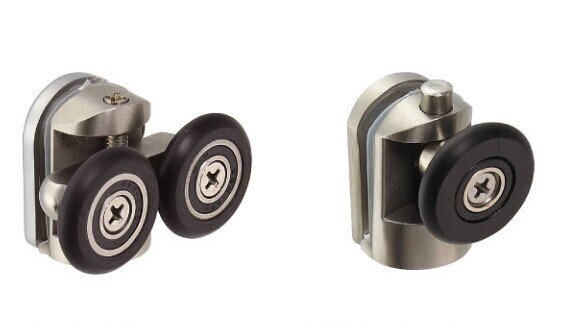
Nylon synthetic wheels serve as the industry standard for specific applications. Their primary success criteria include superior moisture resistance and exceptionally quiet operation. Nylon naturally dampens vibration. This makes it ideal for residential settings where noise reduction takes priority. It glides smoothly over aluminum tracks without causing metal-on-metal wear.
However, nylon comes with specific trade-offs. The material remains susceptible to cold flow deformation. If subjected to heavy, thick glass over long periods, the continuous static load causes the nylon to warp slightly out of round. This deformation leads to the stuttering effect mentioned earlier. Injection-molded nylon performs better than cheap plastic alternatives, but it still has weight limits.
The best use case for Nylon Shower Door Rollers involves standard framed enclosures and light-duty frameless doors. In these applications, the glass weight remains well within the structural limits of the polymer. They provide an excellent balance of operational smoothness and moisture deflection for standard residential bathrooms.
Metal hardware serves an entirely different structural purpose. The success criteria for Stainless Steel Shower Rollers center on exceptional load-bearing capacity and absolute structural rigidity. Metal wheels will not deform under heavy static loads. They maintain their perfect circular geometry regardless of the glass weight they support.
The primary trade-off involves corrosion resistance verification. You must verify the hardware is marine-grade, specifically 304 or 316 stainless steel. Lower grades rust rapidly in humid, high-calcium shower environments. Rust compromises the rolling mechanism and stains the glass and track. Proper passivation during manufacturing ensures the steel resists oxidation.
The best use case for solid metal hardware includes heavy-duty commercial applications, hospitality environments, and enclosures utilizing thick, oversized tempered glass panels. These environments demand maximum durability and resistance to heavy daily use. Metal hardware ensures the heavy glass remains safely suspended without risk of wheel collapse.
Hybrid configurations offer a compelling middle ground. These units combine robust metal housings with synthetic outer wheels. Evaluate these hybrids for their ability to balance durability with noise dampening. The metal housing provides the necessary structural rigidity to support heavy glass panels safely without bending the mounting shaft.
Simultaneously, the synthetic wheel surface prevents metal-on-metal grinding against the track. This combination extends the lifespan of the aluminum track while supporting higher weight limits than pure plastic assemblies. Zinc alloy housings provide excellent corrosion resistance when properly plated. They serve as a viable alternative to solid stainless steel in moderately demanding environments.
Material Type | Load Capacity | Moisture Resistance | Best Application |
|---|---|---|---|
Nylon | Light to Medium | Excellent | Standard residential framed doors |
Stainless Steel (316) | Heavy | High (Marine Grade) | Commercial, thick frameless glass |
Zinc Alloy Hybrid | Medium to Heavy | Good (Requires Plating) | Upgraded residential, hospitality |
Guesswork has no place in hardware replacement. Establishing a digital caliper standard is mandatory. Tape measures lack the necessary precision for this work. Use digital calipers to determine the exact wheel diameter and wheel thickness. A deviation of just one or two millimeters causes the new wheel to bind in the track or jump out entirely. You must also note whether the wheel profile is flat, convex, or grooved to match the existing track extrusion.
You must measure the glass bore hole dimensions accurately. The threaded shaft of the new Shower Door Rollers must pass through this hole without excessive play. If the shaft is too thick, it will not fit. If it is too thin, the door shifts and sags during operation, placing dangerous stress on the glass.
Measuring the glass-to-hole edge distance is equally vital. This represents the distance from the edge of the glass panel to the center of the mounting hole. If you purchase hardware with an incorrect offset, the new housing hits the glass edge before the mounting screw aligns with the hole. This renders the replacement part completely useless.
Remove the existing wheel assembly from the glass panel using a manual screwdriver.
Measure the outer diameter of the wheel in millimeters using digital calipers.
Measure the thickness of the wheel profile.
Measure the diameter of the hole drilled through the tempered glass.
Measure the distance from the center of the glass hole to the top edge of the glass.
Understanding the mechanical design of the mounting shaft dictates your purchasing decision. You must distinguish between eccentric and concentric mechanisms. Concentric hardware features a fixed, centered mounting shaft. It offers no height adjustment. The door sits exactly where the hole was drilled.
Eccentric hardware features an off-center mounting shaft. Rotating the internal cam mechanism raises or lowers the glass panel. Eccentric rollers are mandatory for non-square door frames. Very few bathroom walls are perfectly plumb. Eccentric mechanisms allow for micro-adjustments in height and plumb. This ensures the door seals perfectly against the wall frame and glides without binding.
Amateur installation mistakes frequently lead to catastrophic failures. The most severe risk involves over-tightening the mounting screws. Tempered glass possesses incredible strength against blunt force but remains highly vulnerable to localized pressure points. Mitigation requires strict discipline: always use hand tools. Power tools introduce localized stress that leads to sudden tempered glass explosions. Tighten the screws hand-tight, then add a quarter turn. Use a medium-strength thread locker to prevent the screw from backing out over time.
Asymmetrical loading presents another significant risk. If one wheel sits lower than the others, it carries a disproportionate amount of the door weight. Mitigation involves careful calibration. Ensure all hardware is set to identical heights. The weight must distribute evenly across the entire track to prevent premature bearing collapse.
Incorrect hardware pairing guarantees a short lifespan for the new components. Never mix new hardware with worn legacy hardware. The worn wheels force the door to sit at an angle. This uneven alignment forces the new components to absorb lateral stress they were not designed to handle. Mitigation is simple: always replace the entire set simultaneously.
Proper maintenance extends the lifespan of the new hardware exponentially. Understanding lubrication science prevents rapid degradation. Petroleum-based lubricants are highly destructive to nylon and rubber components. They cause the polymers to swell, soften, and eventually disintegrate. Advocate strictly for silicone-based or PTFE dry lubricants. These compounds reduce friction without chemically attacking the synthetic materials.
Establish a strict preventative cadence. Routine cleaning of the track and hardware housing prevents calcium buildup. Use a soft brush and a mild, non-abrasive cleaner to remove soap scum and hard water deposits. Keeping the track clear of physical obstructions ensures the bearings do not work against accumulated debris. This preserves their internal integrity and maintains a smooth glide.
Procuring hardware from unverified sources often results in premature failure. Demand transparency from your chosen vendor. Ensure your Shower Roller Supplier provides detailed dimensional drawings for every component. Visual matching fails consistently; you need exact millimeter specifications to guarantee compatibility.
Demand material composition verification. If purchasing metal components, request a certificate confirming 304 or 316 stainless steel. Low-grade steel disguised as premium hardware rusts within months. A reputable vendor readily supplies this documentation to prove the metallurgical integrity of their products.
Prioritize suppliers who offer dedicated technical support. Identifying legacy parts represents a major pain point when original manufacturer documentation is lost. A vendor with a knowledgeable technical team analyzes photos and measurements of your broken hardware to identify the correct modern equivalent. This value-add service saves countless hours of frustrating trial and error.
Replacing worn sliding mechanisms at the first sign of friction acts as a highly effective intervention. It prevents catastrophic glass breakage, eliminates track wear, and restores the structural integrity of the enclosure. Ignoring grinding noises or heavy resistance only compounds the damage, leading to more complex repairs down the line.
Base your procurement logic entirely on exact dimensional matches and the specific load-bearing requirements of your door type. Do not guess measurements or compromise on material quality. High-grade nylon or verified marine-grade stainless steel provides years of reliable, safe operation.
Execute your replacement project by following these immediate steps:
Extract one existing wheel assembly to use as a physical reference sample.
Record the wheel diameter, thickness, and glass hole dimensions using a calibrated digital caliper.
Source a complete, matching replacement set to guarantee uniform weight distribution.
Mount the new components using manual hand tools to avoid localized stress on the tempered glass.
Coat the track with a PTFE dry lubricant to establish long-term, frictionless operation.
A: Replacing the rolling hardware requires a fraction of the investment needed for a total unit replacement. Timely hardware replacement preserves the existing tempered glass and aluminum frame. This approach eliminates the heavy labor and material expenses associated with tearing out and installing a completely new enclosure, making it a highly efficient maintenance strategy.
A: You must always replace the entire set simultaneously. Mixing new hardware with worn legacy components causes asymmetrical weight distribution. The new wheel bears excessive lateral stress, leading to premature failure. Replacing all units ensures the door remains perfectly plumb and the weight distributes evenly across the track.
A: Inspect the mounting shaft where it passes through the glass. If the screw sits dead-center in a perfectly round housing, it is concentric and non-adjustable. If the screw sits off-center, or if the housing features an internal rotating cam mechanism, it is eccentric. Eccentric designs allow you to adjust the vertical height.
A: High-quality nylon components typically last three to five years under normal residential use before showing signs of wear. Marine-grade stainless steel components can last seven to ten years or more, provided the track remains clean. Lifespan depends heavily on water hardness, cleaning frequency, and the weight of the glass panel.
A: No metal is entirely rust-proof, but 316 marine-grade stainless steel is highly rust-resistant. It contains molybdenum, which specifically prevents chloride corrosion found in salt air and hard water. Lower grades resist rust well in standard bathrooms but may show surface oxidation in extreme salt-air environments over time.
A: Use a mixture of warm water and white vinegar to dissolve hard calcium deposits. Apply the solution, let it sit for ten minutes, and scrub with a stiff nylon brush. Never use abrasive metal wire brushes, as they scratch the aluminum track. Wipe the track completely dry before installing the new hardware.
A: Yes, upgrading is possible if the dimensional specifications match exactly. The wheel diameter, thickness, and glass hole offset must be identical to the original nylon parts. However, ensure your aluminum track handles metal wheels. In some lightweight frames, stainless steel wheels cause accelerated wear on thin aluminum tracks.


