

Views: 0 Author: Site Editor Publish Time: 2026-08-18 Origin: Site


Frameless and semi-frameless glass shower enclosures offer premium aesthetics, but they are highly susceptible to functional failures. Persistent leaks, drafts, and water damage occur quickly if perimeter gaps remain unmanaged. Water escaping through hinge gaps, degraded bottom sweeps causing door friction, and failed temporary fixes lead to structural water damage. Makeshift repairs like excessive silicone or duct tape only invite mold proliferation and safety hazards. Resolving these issues requires moving past DIY hacks. You must evaluate engineered solutions based on exact measurements. Identifying and installing the correct glass shower door seal is the most effective way to restore watertight integrity. It ensures proper door alignment and extends the lifespan of the enclosure. We will diagnose common failures, select the right extrusion profiles, and execute a professional-grade installation.
Root Cause Identification: Most frameless shower leaks stem from incorrect gap management rather than glass failure; resolving this requires specific extrusion profiles (e.g., h-jamb, bulb, or sweep) tailored to the exact leak point and water pressure.
Material Science Matters: Cheap plastics degrade, yellow, and become brittle under UV exposure and hard water. Long-term performance relies on architectural-grade polycarbonate or high-quality vinyl.
Precision Tolerances: A waterproof shower seal must perfectly match the glass thickness (typically 3/8" or 1/2") to prevent hinge strain, door sagging, and micro-fractures.
Supplier Reliability: Partnering with a specialized shower door seal supplier ensures access to exact-match, commercial-grade extrusions rather than generic, ill-fitting aftermarket strips.
High-pressure showers push water directly against vertical hinge gaps and bottom thresholds. Frameless enclosures rely entirely on tight tolerances to keep water inside. When those tolerances fail, water escapes rapidly. Capillary action pulls moisture under the glass edge, dragging it out onto the bathroom floor. Modern shower panels and multi-jet fixtures direct excessive volume against these frameless gaps. Standard plastic strips fail under this continuous pressure. Heavy-duty waterproof shower seal profiles become necessary to block the spray. Ignored leaks compound costs over time. Subfloor rot develops silently beneath the bathroom tile. Drywall degradation weakens the surrounding structure. Costly mold remediation follows when moisture remains trapped in unventilated spaces. Body sprays hitting the hinge side exacerbate the issue. If the shower curb pitches outward even 1/16 of an inch, water pools against the sweep and eventually breaches the barrier.
Improper floor clearance creates severe mechanical issues. Friction from worn bottom sweeps exacerbates hinge sag. As the plastic fins flatten, they drag across the threshold. This dragging creates leverage against the heavy glass panel. Hardware loosens over time due to this repeated stress. You must differentiate seal friction from actual hardware failure. A dragging door often mimics a broken hinge. Before installing a new glass door seal, realign the door using shims and suction cups. Correct dropped hinges first to restore proper clearance. Misaligned heavy glass doors dragging against tile create structural risks. The tempered glass can shatter if the edge strikes a hard surface repeatedly. Check the hinge plate gaskets during this process. Neoprene gaskets compress over years of use, causing the glass to slip downward and bind against the curb.
Unsealed vertical gaps heavily impact ambient temperature. Convection currents pull cold air into the shower area. Hot water creates steam, forcing air out the top. Cold air rushes in through the hinge gaps to replace it. User comfort drops significantly in a dedicated shower room. Installing a proper shower room seal improves steam retention. It blocks the cold air intake at the perimeter. Thermal efficiency increases, keeping the enclosure warm during use. Bathroom exhaust fans make this worse. A standard 100 CFM fan creates negative pressure in the room. It actively sucks cold air through any unsealed 1/8-inch gap around the door. Closing these gaps stops the draft and keeps the heat inside the enclosure where it belongs.
Low-grade PVC seals fail quickly compared to high-grade materials. Plasticizers leach out of cheap vinyl over time. Hard water scale, soap scum, and UV light break down inferior plastics. The material turns yellow and becomes highly brittle. Cracking and aesthetic ruin follow shortly after. Trapped moisture from failing seals contributes to permanent mineral etching. Calcium and magnesium embed into the adjacent glass panels. Fogging compounds the aesthetic damage, making the entire enclosure look permanently dirty. A hard water index above 7 grains per gallon accelerates this breakdown. The calcium carbonate bonds to the porous surface of the glass and the degraded plastic, creating a crust that standard cleaners cannot remove.
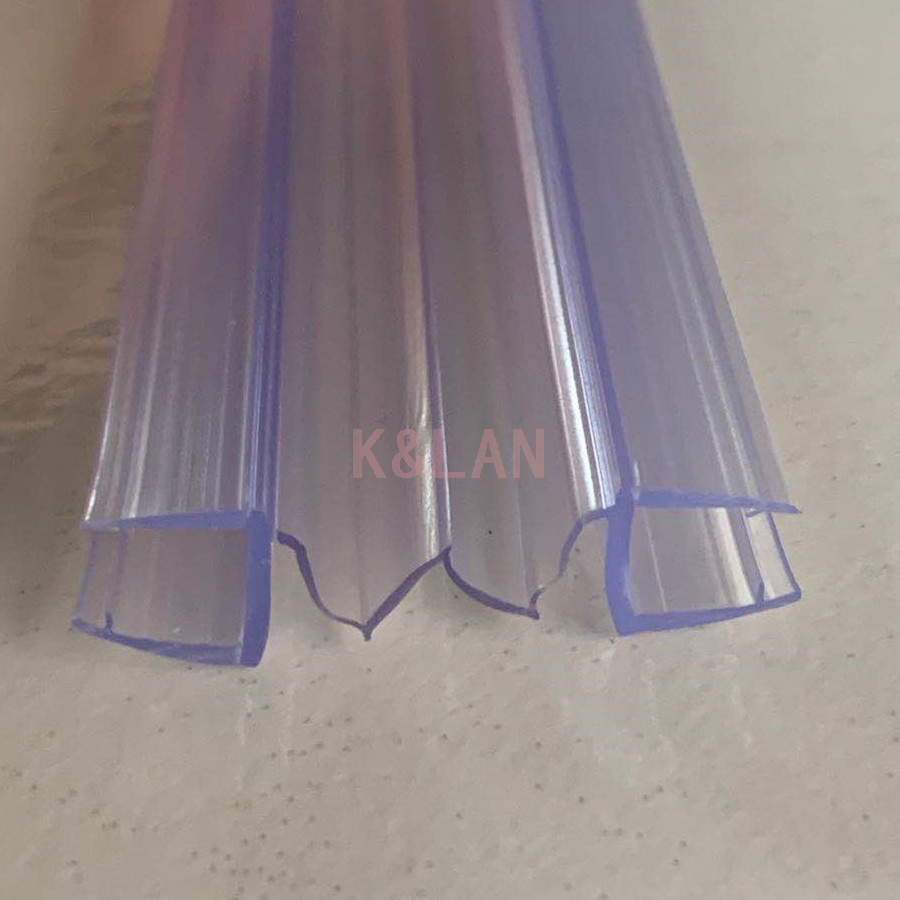
Bottom sweeps deflect water back into the shower pan. They slide onto the bottom edge of the moving door. Design variations include single fin, double fin, and drip rail combinations. A drip rail features a rigid lip angled inward. It catches water running down the glass and directs it away from the gap. Selection depends on threshold design and floor slope. Flat thresholds require longer fins to maintain contact. Sloped thresholds work better with shorter, stiffer fins to prevent dragging.
Measure the exact width of the glass door bottom using a tape measure.
Cut the new sweep 1/16-inch shorter than the glass width to prevent binding at the hinge side.
Clean the bottom edge of the glass with isopropyl alcohol to remove soap residue.
Push the sweep onto the glass starting from the handle side, working your way toward the hinge.
Bulb seals compress to close gaps between glass panels or glass-to-wall interfaces. The hollow bulb flattens upon contact. They do not impede the door swing during operation. H-Jambs apply to 180-degree inline doors to prevent water bypass. The rigid "H" shape overlaps the adjacent fixed panel. U-Channel profiles push directly onto the glass edge to provide a clean bumper. They protect the glass from striking the wall or metal frame.
Profile Type | Primary Function | Best Application |
|---|---|---|
Bulb Seal | Compresses to fill irregular gaps | Hinge side gaps and wall interfaces |
H-Jamb | Overlaps adjacent glass to block water | 180-degree inline fixed panels |
U-Channel | Acts as a soft bumper | Handle side striking a wall |
Magnetic profiles ensure a positive, watertight closure. They are primarily used for double doors or specific frameless configurations. The magnets pull the doors together, eliminating the center gap entirely. Trade-offs exist between magnetic tension and ease of opening. Sticking shower doors often result from overly strong magnets. Users must pull harder to break the magnetic bond. This extra force can strain the hinges if the glass is particularly heavy. Pay attention to polarity during installation. If you install the strips backward, they will repel each other instead of locking the doors together.
Material properties directly dictate longevity. Polycarbonate offers superior UV resistance compared to standard vinyl. It prevents yellowing and maintains its clear appearance. Polycarbonate also features excellent memory retention. The fins snap back into place after the door opens. The seal avoids flattening over time. Assess chemical resistance against harsh bathroom cleaning agents and mineral descalers. High-grade materials withstand bleach and ammonia without degrading. Co-extruded profiles combine a rigid polycarbonate spine with soft vinyl fins for optimal performance. This hybrid approach gives you the gripping power of rigid plastic and the water-blocking flexibility of soft rubber.
Debunk the universal fit myth immediately. Extrusions rely on precise mechanical tension to stay attached. Evaluate specifications based on exact glass thickness. Common sizes include 1/4", 5/16", 3/8", and 1/2". Using a seal meant for 1/2" glass on a 3/8" panel guarantees it will fall off. Ensure tension-fit security without requiring adhesives. Measure your glass with digital calipers before ordering. Do not guess the thickness with a standard tape measure, as the difference between 5/16" and 3/8" is visually minimal but mechanically significant.
Glass Thickness (Inches) | Metric Equivalent (mm) | Recommended Profile Type | Primary Application |
|---|---|---|---|
1/4" | 6mm | U-Channel with Soft Fin | Lightweight semi-frameless doors |
5/16" | 8mm | Magnetic Strip Pair | Double sliding or swinging doors |
3/8" | 10mm | Co-extruded Bottom Sweep | Standard heavy frameless doors |
1/2" | 12mm | Heavy-Duty H-Jamb | Architectural large-format glass |
Analyze the balance between a tight seal and smooth door operation. Overly rigid fins cause jarring closures. The door bounces back instead of shutting cleanly. Sticking doors lead to micro-fractures in tempered glass over time. The constant vibration weakens the hinge cutouts. Select profiles with flexible fins that compress easily. Test the door swing after installation to ensure the hinges operate without resistance. A standard frameless door needs a 3/16-inch to 1/4-inch gap at the bottom for the sweep to function without binding. If your gap is smaller, you must adjust the hinges upward before attaching the extrusion.
Applying push-on seals over hard water scale results in weak bonding. Old adhesive residue prevents the rigid spine from seating fully. Moisture gets trapped in these micro-gaps. Black mold develops rapidly behind the plastic. Establish strict chemical descaling and mechanical cleaning protocols. Use white vinegar or commercial descalers to dissolve mineral buildup. Employ non-abrasive tools like plastic razor blades to scrape the edge. Avoid metal scrapers to prevent glass scratches prior to installation.
Spray the glass edge with a heavy-duty liquid descaler.
Let the solution sit for 10 minutes to break down stubborn calcium deposits.
Scrape the edge aggressively with a plastic razor blade to remove the crust.
Wipe the edge completely dry with a clean microfiber cloth.
Imprecise cuts leave micro-gaps at the corners. When bottom sweeps meet vertical hinge seals poorly, they create localized leak points. Water channels directly into these empty spaces. Emphasize precision measuring for every piece. Use proper cutting tools like miter shears or fine-tooth hacksaws. Utility knives crush the rigid plastic profile during the cut. Miter shears provide a clean 90-degree or 45-degree angle without distorting the shape. Sometimes you have to cope the vertical seal around the bottom sweep to ensure a tight fit. Leave a 1/16-inch expansion gap at the corners to prevent the plastics from buckling against each other when the door closes.
Using silicone caulk to compensate for an ill-fitting shower seal creates messy bonds. Duct tape and other internet-sourced makeshift repairs fail quickly under moisture. These materials act as mold traps. They look unprofessional and degrade within weeks. Source exact-match extrusion profiles instead. Rely entirely on mechanical tension-fit for sealing. Eliminate messy adhesives completely. A correct profile snaps onto the glass tightly without any chemical assistance. Silicone cannot handle the shear stress of a door opening and closing daily. It will peel away from the glass edge within a few months, leaving you with a bigger mess than you started with.
Contractors, facility managers, and discerning homeowners should bypass big-box retail. Retail stores typically stock generic, low-grade PVC strips. Source directly from a dedicated shower door seal supplier. Access bulk, architectural-grade extrusions for consistent quality. Commercial-grade materials offer long-term durability against UV light and hard water. They maintain their structural integrity far longer than residential alternatives. Commercial suppliers use precision extrusion dies that maintain exact tolerances. This ensures the piece you buy today matches the piece you buy five years from now.
A reliable supplier stocks a comprehensive catalog of legacy profiles. Older enclosures often require specific shapes no longer found in retail stores. They also carry modern frameless solutions. Evaluate suppliers based on technical support capabilities. Look for dimensional diagrams with exact millimeter measurements. Sample availability allows you to test the fit before committing to a bulk order. Accurate cross-section drawings ensure you match the replacement part perfectly. You need to see the exact profile shape, fin length, and grip width before making a purchase.
Measure your glass thickness with digital calipers to determine the exact millimeter requirement for your replacement extrusions.
Identify the specific failure point at the bottom threshold, vertical side, or hinge gap to select the correct profile shape.
Realign your door hinges using shims and suction cups to restore proper clearance before installing new extrusions.
Clean and descale the glass edges thoroughly with a plastic razor blade and chemical descaler before snapping the new profiles into place.
A: Measure the thickness of your glass door using digital calipers. Common sizes are 1/4", 5/16", 3/8", and 1/2". Next, measure the width of the gap between the glass and the adjacent surface. Match these two measurements to the dimensional drawings provided by the supplier.
A: Bottom leaks typically result from worn bottom sweeps, improper threshold slope, or missing drip rails. High-pressure shower panels can also force water past standard fins. Replacing the flattened sweep with a co-extruded profile featuring a rigid drip rail usually resolves the issue.
A: No. Silicone is a poor substitute for a mechanical tension-fit extrusion. It lacks durability on moving edges, creates weak bonding over time, and harbors black mold. A proper extrusion snaps onto the glass securely without requiring messy, unreliable adhesives.
A: Replacement timelines depend on material quality, water hardness, and usage frequency. High-grade polycarbonate seals last 3 to 5 years. Cheaper vinyl profiles may become brittle, yellow, and require replacement every 12 to 18 months under heavy use.
A: Fixing center gaps requires installing bulb seals, H-jambs, or magnetic strips depending on the door configuration. You must also check the hinges. If the door has sagged, adjusting the hinges with shims will close the gap before applying the new extrusion.
A: Sweeps attach to the bottom of the door to deflect water back into the shower pan. Bulb seals attach to the vertical edges. The hollow bulb compresses to close gaps between glass panels or walls without impeding the door swing.


