

Views: 0 Author: Site Editor Publish Time: 2026-06-03 Origin: Site


A failing shower enclosure creates more than just annoying puddles. It actively accelerates grout degradation. It promotes hidden mold growth. It triggers costly water damage underneath your bathroom tiles. Many homeowners treat seal replacement as a frustrating guessing game. They buy generic strips based on visual estimates rather than precise measurements. This oversight leads to quick re-failures caused by thermal expansion mismatches. Incorrect compression profiles also ruin the fit.
Instead of guessing, you need a systematic framework. An engineering-based approach helps you measure, select, and install a commercial-grade replacement. We will show you exactly how to evaluate your glass. You will discover how to choose an option tailored for absolute longevity. You will learn professional sizing techniques and essential material science basics. These actionable steps ensure a watertight finish for years to come.
Never measure your old seal: It has already warped and lost its original structural integrity. Always measure the raw glass and the physical gap.
Match the material to the environment: Dual-density structures offer the best balance of rigid grip and flexible sealing compared to single-extrusion plastics.
Mind the door mechanics: Pivot doors require deflectors, not full-compression seals, to avoid excessive friction and hinge damage.
Pre-installation prep dictates lifespan: Skipping surface decontamination (using 90%+ isopropyl alcohol) is the #1 cause of premature adhesive or friction failure.

Most basic replacement strips fail well before their expected lifespan. You cannot blame this entirely on normal wear and tear. Basic physical realities explain why unexpected leaks occur so frequently in residential bathrooms. Standard options lack the structural engineering required for daily abuse.
Uneven compression destroys cheap models quickly. Single-density structures deform permanently when compressed repeatedly. They flatten out against uneven tray surfaces. Once they lose their original shape, they cannot bounce back. This permanent deformation creates microscopic pathways for water escape.
Thermal expansion mismatch presents another massive engineering hurdle. Cheap plastics expand and contract poorly. They react differently than tempered glass under boiling hot water. This constant shifting causes micro-gaps. The strip slowly wiggles loose from its intended mounting position over time.
Finally, surface contamination ruins even the most expensive replacements. Microscopic soap scum acts as a barrier. Hard water calcification prevents new models from seating properly. You must remove these invisible barriers before you install anything. Otherwise, your brand-new barrier will slide out of place within weeks.
You cannot eyeball millimeter-level tolerances. Getting the exact size requires a definitive, skeptical-friendly formula. You must treat this process like a precision engineering task. Follow these three exact steps to identify your required dimensions.
Measure the Glass Thickness (The Caliper Rule)
Standard panel sizes typically measure 6mm, 8mm, or 10mm thick. You must use digital calipers for this step. Do not rely on a standard tape measure. Measure slightly away from the absolute edge. Glass edges often feature microscopic bevels. Using an 8mm profile on 6mm glass guarantees a loose fit. It will slide down constantly.
Measure the Free Space (The Gap)
You must calculate the exact free space available. Measure the vertical distance from the bottom edge of the glass directly to the tray. Do not measure your old broken strip. Measure the pure empty space. This measurement dictates how long the lower lip must be.
Account for Glass Shape & Bending Limits
Straight enclosures and rounded enclosures require completely different approaches. Curved panels mandate the use of a soft metric tape. Materials have strict physical bending limits. Rigid profiles can handle roughly 15 degrees per foot of bending. Exceeding this limit causes extreme wrinkling. You must buy specialized narrow profiles for tight curves.
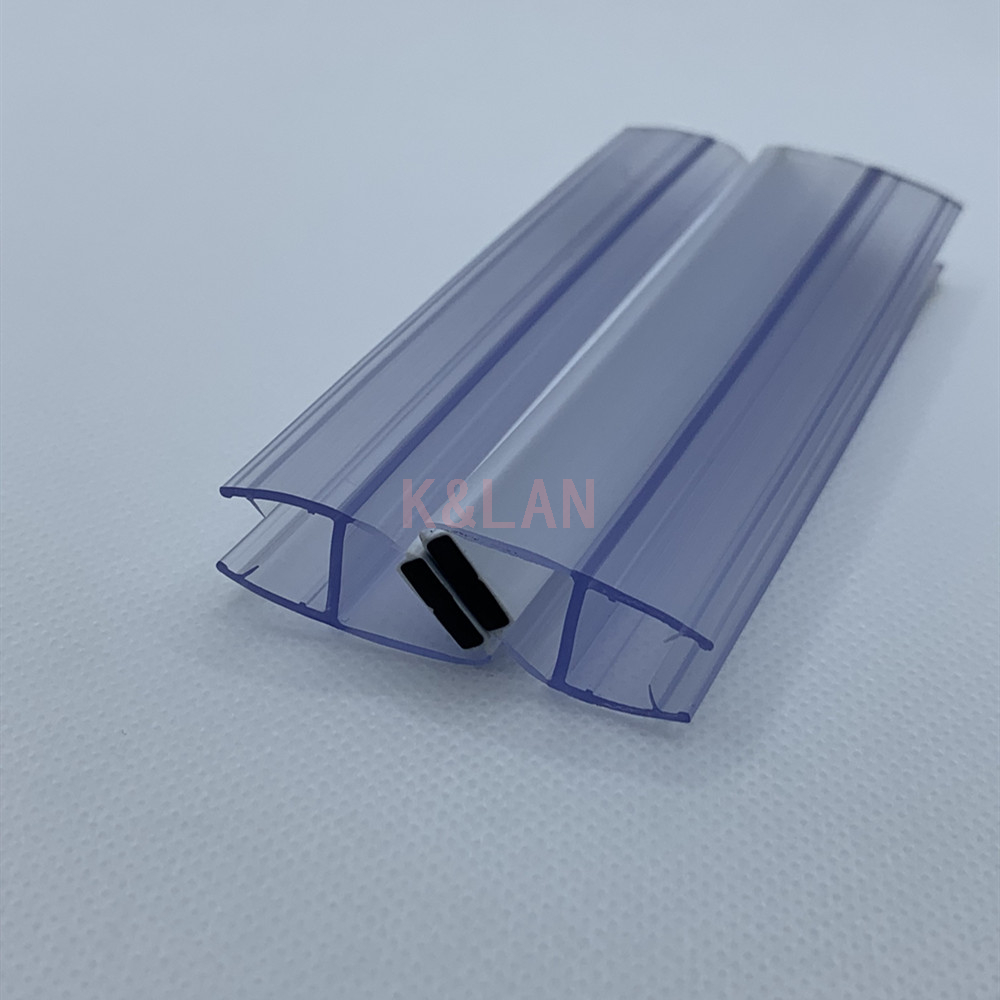
Manufacturers rely on two dominant materials for bathroom enclosures. You must compare them using an evidence-based lens. Each material handles stress, temperature, and friction differently. Understanding material architecture prevents premature failures.
Standard and dual-density PVC options dominate the market. The best versions utilize a dual-channel compression design. A rigid polycarbonate inner core grips the glass heavily. Meanwhile, a soft outer lip absorbs surface imperfections. This structural combination is highly durable. However, a standard PVC seal remains susceptible to UV yellowing. Harsh chemical cleaners will also turn them brittle if left untreated.
On the other hand, pure silicone offers unmatched elasticity. It boasts extremely high thermal tolerance. A premium silicone seal will never turn brittle over time. It is naturally mold-resistant. However, it presents unique challenges. It often requires adhesive assistance to stay in place. It can also feel overly pliable for heavy-duty gaps.
Material Comparison Chart | |||
Material Type | Structural Design | Thermal Tolerance | Best Use Case |
|---|---|---|---|
Single-Density PVC | Uniform plastic extrusion | Low (Prone to warping) | Temporary fixes on straight doors |
Dual-Density PVC | Rigid core, soft sweeping lip | Moderate to High | Standard sliding and hinged doors |
Pure Silicone | Highly elastic, single body | Extremely High | Curved glass and frameless setups |
You must categorize your solutions by deployment type. Different designs suit entirely different environments. Choosing the wrong mounting style causes immediate frustration. We can break these down into three primary deployment strategies.
Clip-on versions rely entirely on friction. They are ideal for standard sliding doors. Framed enclosures benefit greatly from this style. They leave no sticky glue residue behind. They are highly secure and very easy to swap later. However, they require exact millimeter matching to work correctly.
Tape-backed strips offer a different approach. They suit frameless minimalist enclosures perfectly. They work well for temporary fixes or irregular curves. They offer incredibly easy bathroom installation without requiring special tools. Unfortunately, they remain highly vulnerable to humidity degradation. Poor surface preparation will cause the adhesive to fail rapidly.
Aluminum channel models provide ultimate security. High-traffic commercial environments rely on them exclusively. Multi-user residential bathrooms benefit from their durability. They represent the most robust solution available. However, they require permanent drilling into the frame. They carry a higher upfront cost and demand professional tools.
Complex buyer scenarios require deep niche expertise. Standard solutions often fail in specialized situations. You must adapt your approach for unique door mechanics. Two common edge cases ruin standard replacement attempts.
The pivot door trap catches many homeowners off guard. Fully sealing the bottom of a hinged door is dangerous. It creates massive vacuum friction against the floor. This friction causes the door to jam tightly. It places severe mechanical stress on the hinges. Instead, you should install a simple water deflector. A drip rail channels water back into the tray. It does not block the gap entirely.
Magnetic closures demand completely different specifications. They provide watertight corner closures for 90-degree or 180-degree configurations. You cannot buy weak magnets for this task. You must look for a magnetic pull strength of at least 24 N/cm. This specific metric ensures a heavy, satisfying closure. A strong Shower Seal with heavy magnets easily resists high water pressure.
Feature | Magnetic Closures | Standard Friction Sweeps |
|---|---|---|
Water Resistance | Exceptional at corners | Moderate at door bottom |
Mechanism | Polarized attraction (24 N/cm) | Physical overlapping lips |
Wear Rate | Very low (no rubbing) | High (constant floor scraping) |
Practical, field-tested realities separate amateurs from professionals. You must follow strict guidelines to build ultimate trustworthiness into your project. Cutting corners during prep work guarantees failure.
Surface preparation dictates everything. You must clean the raw edge thoroughly. Use 90% or higher isopropyl alcohol. Do not use standard household bathroom cleaners. Standard sprays leave a microscopic chemical film. This film prevents proper seating and destroys adhesives.
You must understand the thermodynamics trick for rigid materials. Cold plastic feels extremely rigid. It remains highly prone to snapping under pressure. You should use a hairdryer on low heat. Alternatively, soak the strip in warm water for ten minutes. This increases malleability significantly before fitting.
Troubleshooting the final fit requires patience. If the strip feels too tight, do not force it. Apply a single drop of liquid dish soap. It acts as a temporary slip agent. If the fit feels slightly loose, do not panic. Use a minimal bead of translucent silicone inside the channel. This locks it down for a completely leak-proof finish.
You must set realistic maintenance expectations. These barriers are consumable items. A two-year replacement cycle represents the industry standard. Maintain your setup weekly. Use an old toothbrush and warm soapy water. Scrub gently to clear out abrasive mildew and hard water deposits.
A successful project depends entirely on accuracy. You must nail the exact gap measurement first.
Matching the material density to your specific mechanical action is non-negotiable.
Do not guess your glass thickness. Grab digital calipers today and measure your precise parameters.
Shortlist dual-density models or magnetic options based on the engineering frameworks provided above.
Watch a professional installation video guide before cutting your newly purchased materials.
A: No. Cyanoacrylate degrades quickly in wet environments. Superglue ruins the glass finish permanently. It becomes brittle and snaps under thermal expansion. Use translucent bathroom-grade silicone for gap filling instead.
A: This happens due to uneven tray compression. Choosing a single-density strip instead of a dual-density model is a common mistake. Cutting the plastic too short without accounting for material shrinkage also causes immediate leaks.
A: Avoid using standard household scissors. They crush the plastic core. Use a fine-tooth hacksaw. PVC pipe cutters or heavy-duty secateurs work perfectly. Always sand the freshly cut edges smooth before installation.

